German for your first month: 25 phrases for real situations
25 German phrases for your first month in Germany, each with a likely reply: asking for help, shopping, collecting parcels, flat viewings and appointments.

Easy German Guide team, reviewed by our teachers
· 6 min read
Quick answer
For your first month in Germany, learn short phrases for five situations: asking people to slow down or repeat, shopping, collecting parcels, viewing a flat and making appointments. Learn a likely reply with each one, use Sie with strangers, and keep Könnten Sie das bitte aufschreiben? ready for names, dates and addresses.
In this article
You've practised Ich möchte … at home. At the counter, you say it perfectly. Then the person replies, and suddenly the conversation has gone somewhere your app never mentioned.
For your first month in Germany, learn a few likely replies alongside the sentences you want to say. You don't need a speech. You need an opening, a way to understand the answer and a way to ask for help.
These 25 phrases cover five everyday situations. The replies are original practice examples, not fixed scripts. Real people will use different words.
What to say when the conversation moves too fast
These are useful even when you know very little German. Asking someone to repeat a sentence is part of having a conversation.
- You say: Entschuldigung, ich lerne noch Deutsch.Sorry, I'm still learning German.Possible replyKein Problem.No problem.
- You say: Könnten Sie bitte etwas langsamer sprechen?Could you speak a little more slowly, please?Possible replyJa, natürlich.Yes, of course.
- You say: Könnten Sie das bitte wiederholen?Could you repeat that, please?Possible replyIch sagte: am Donnerstag.I said: on Thursday.
- You say: Was bedeutet das?What does that mean?Possible replyDas bedeutet, dass Sie warten müssen.It means you have to wait.
- You say: Könnten Sie das bitte aufschreiben?Could you write that down, please?Possible replyJa, einen Moment bitte.Yes, one moment, please.
For names, dates and addresses, writing can help more than a third repetition. Keep your phone's notes app or a small notebook ready.
What to say at the supermarket or bakery
- You say: Wo finde ich Hafermilch?Where can I find oat milk?Possible replyIm zweiten Gang, links.In the second aisle, on the left.
- You say: Ich hätte gern zwei Brötchen.I'd like two bread rolls.Possible replyWelche möchten Sie?Which ones would you like?
- You say: Kann ich mit Karte bezahlen?Can I pay by card?Possible replyJa, bitte hier.Yes, here, please.
- You say: Nein danke, ich brauche keine Tüte.No thanks, I don't need a bag.Possible replyAlles klar.All right.
- You say: Den Kassenbon hätte ich gern.I'd like the receipt.Possible replyHier, bitte.Here you go.
Mit Karte, bitte means “By card, please.” It's a useful shorter answer once you know card payment is accepted. Sonst noch etwas? means “Anything else?” You can reply, Nein, danke.
What to say when picking up a parcel
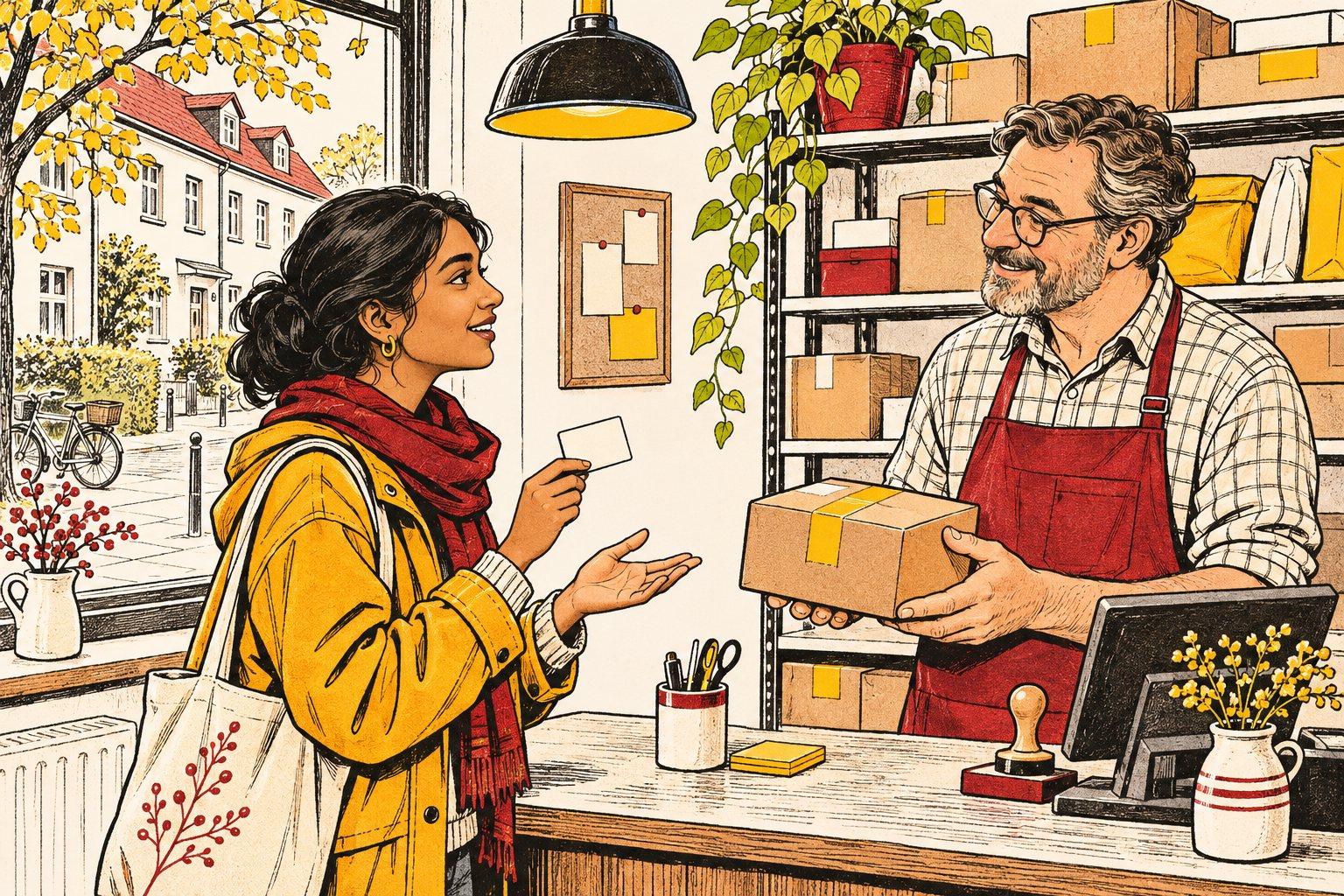
- You say: Ich möchte ein Paket abholen.I'd like to collect a parcel.Possible replyHaben Sie Ihren Ausweis dabei?Do you have your ID with you?
- You say: Hier ist mein Ausweis.Here is my ID.Possible replyDanke. Wie ist Ihr Nachname?Thank you. What's your surname?
- You say: Die Sendung ist auf meinen Namen.The parcel is addressed to me.Possible replyEinen Moment, ich schaue nach.One moment, I'll check.
- You say: Hier ist die Benachrichtigung.Here is the delivery notification.Possible replyDas Paket liegt in einer anderen Filiale.The parcel is at a different branch.
- You say: Wo muss ich unterschreiben?Where do I need to sign?Possible replyBitte hier unten.Down here, please.
What to ask at a flat viewing
- You say: Ist die Wohnung noch frei?Is the flat still available?Possible replyJa, sie ist noch frei.Yes, it's still available.
- You say: Wie hoch ist die Warmmiete?How much is the rent including the stated additional charges?Possible replySie beträgt 850 Euro.It's 850 euros.
- You say: Ist Strom in der Miete enthalten?Is electricity included in the rent?Possible replyNein, den zahlen Sie extra.No, you pay for that separately.
- You say: Ab wann kann ich einziehen?When can I move in?Possible replyAb dem ersten Dezember.From the first of December.
- You say: Bekomme ich eine Wohnungsgeberbestätigung?Will I receive confirmation from the housing provider that I've moved in?Possible replyJa, nach dem Einzug.Yes, after you move in.
How to book and attend appointments in German
- You say: Ich möchte einen Termin vereinbaren.I'd like to make an appointment.Possible replyWorum geht es?What's it about?
- You say: Haben Sie nächste Woche einen freien Termin?Do you have an appointment available next week?Possible replyAm Dienstag um zehn Uhr.On Tuesday at ten.
- You say: Welche Unterlagen muss ich mitbringen?Which documents do I need to bring?Possible replyBitte bringen Sie Ihren Reisepass mit.Please bring your passport.
- You say: Ich habe um zehn Uhr einen Termin.I have an appointment at ten.Possible replyWie heißen Sie?What's your name?
- You say: Ich muss meinen Termin verschieben.I need to reschedule my appointment.Possible replyWann hätten Sie Zeit?When would you be available?
The passport reply is a language example, not a document checklist. What you need depends on the appointment. Ask for a written list or check the service's official page.
Try one complete conversation
- YouIch möchte einen Termin vereinbaren.I'd like to make an appointment.
- ReceptionWorum geht es?What's it about?
- YouEs geht um meine Anmeldung.It's about registering my address.
- ReceptionAm Donnerstag um neun Uhr?On Thursday at nine?
- YouKönnten Sie das bitte aufschreiben?Could you write that down, please?
Notice the useful part: you didn't understand every possible reply in advance. You had a way to keep going.
How should you practise these phrases?
| Time | What to do |
|---|---|
| 2 min | Read three phrases and their replies. |
| 3 min | Cover the German and say the phrases from the English prompts. |
| 3 min | Let a partner change a date, quantity or item. |
| 2 min | Repeat the part you missed. |
If you're already in Germany, try one phrase in an appropriate everyday interaction. Afterwards, note what the other person actually said. That gives you your next lesson.
Want to practise these conversations with Easy German Guide? Tell us which situations you find hardest and your current level when you enquire about classes.
Key takeaways
- Learn a likely reply with every phrase, not just the sentence you want to say.
- Asking someone to repeat or slow down is part of the conversation, not a failure.
- Use Sie with strangers and at official appointments.
- Ask what Warmmiete includes. It is not always everything.
- Ten minutes a day on one situation beats memorising the whole list.
Questions learners ask
- What German phrases should I learn first before moving to Germany?
- Start with phrases that keep a conversation going: “Entschuldigung, ich lerne noch Deutsch”, “Könnten Sie bitte etwas langsamer sprechen?” and “Könnten Sie das bitte aufschreiben?”. Then add phrases for the situations you will face first, such as shopping, collecting parcels, flat viewings and appointments.
- Should I use Sie or du with strangers in Germany?
- Use Sie with strangers, staff and at official appointments. It is the polite default. Switch to du when the other person offers it or in clearly informal settings.
- What is the difference between Kaltmiete and Warmmiete?
- Kaltmiete is the base rent. Warmmiete adds the stated additional charges, such as heating and building costs. Electricity and internet are often paid separately, so always ask exactly what the Warmmiete includes.
Sources
Checked .
Learn this with a teacher
Practise A1 German live, in a small group or 1:1, explained in English and Hindi. Next A1 batch starts 5 Jan 2027.